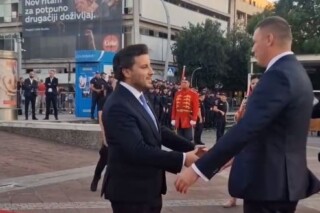
Montenegro has no dilemma when it comes to its path of integration into NATO and the European Union, said prime minister Dusko Markovic in an interview with US magazine Time.
Speaking to the renowned magazine about integration, but also the current political situation and interference and obstruction by third parties, the PM said that since October 2016, we’ve had continuous obstruction of the state and its institutions here, but that we must defend our legal and constitutional order.
Asked whether current geopolitical shifts make Montenegro question its decision to integrate with the West, Markovic said that there was no such dilemma.
“We know that NATO is going to enter a new stage, a new way of doing things. We believe that especially because of this new position of the U.S. and President Trump, NATO will become even stronger,” the PM said in his interview with Time on the eve of the Munich Security Conference, which he will take part in as well as other highest statesmen of Europe and the world.
As he said, the EU is facing some serious problems, but we really believe that once we finish the negotiating process, it will not look as it looks today:
“We believe the EU will be better organised, and its institutions will be reinforced more than today,” Markovic said.
The MP emphasised that it is important for NATO to remain open for all the countries of the Western Balkans, because it will preserve peace in the Western Balkans, which is necessary to preserve stability and peace in Eastern Europe.
Speaking about the reasons why Montenegro aspires to become a NATO member, Markovic noted that permanent conflicts and wars in the Balkans never led to any mechanisms for self-control and the resolution of crises.
“Montenegro is very strategically positioned. It has an exit to the Adriatic Sea. Other countries of the Adriatic, namely Slovenia, Croatia and Albania, are already NATO member states. Montenegro is the only country which is not. It has a very powerful port, the port of Bar. And this port of Bar is strategically important for NATO’s opponents, especially following the conflict in Syria, when Russia started its search for a good naval base in some of the warmer seas,” the prime minister said when asked what NATO has to gain from letting Montenegro join.
When the Time journalist noted that it should not be surprising that Russia has been so resistant to Montenegro joining NATO, Markovic said that Russia has a very strong interest to expand its outreach to the Adriatic coast.
“And the Montenegrin decision to belong to another civilisational circle poses an obstacle,” he added.
“It’s all about the strategic conflict between global interests, the power games between NATO and the West on one side and Russia on the other. Montenegro has cherished for more than 300 years its good friendship with Russia, and we would never allow our territory to be misused in order to disrupt Russian security in any way,” he said.
Nevertheless, as he added, Montenegro is going to defend its own interests and the interests of this Western community that we opted for.
“Enabling Russia to gain power, or to gain dominant influence in the Western Balkans, would mean losing our sovereignty at the same time. And we want to keep that sovereignty for ourselves. So we are not ready to allow Russia to make decisions for us and to direct the course we take,” Markovic said.
Responding to questions about the events on the eve of 16 October last year and activities related to the attempted coup d’état, Markovic said that Russia interfered with the election process in Montenegro and visibly supported the political forces opposed to NATO.
“A lot of money was pumped in illegally. Russian officials were publicly threatening us. Their security services were in touch with politicians, with the Orthodox Church, with NGOs, with some media outlets. An environment was created in which the pro-Western forces were supposed to lose”, the PM explained and said that they were also preparing an alternative scenario, which in the event of a victory for the pro-European forces, would lead to attacks, to conflicts, and the violent overtaking of power.
Markovic explained that the conspiracy was uncovered and added that NATO members’ security services also confirmed information obtained by Montenegrin institutions.
“They helped us to put all of these pieces together, because all of these operations involved the interference of a third party,” the PM said.
Noting that in some parts of eastern Ukraine, local protests against the pro-Western government in Kiev in 2014 grew into major conflicts with Russian state support, the Time’s journalist asked if PM fears that kind of scenario can happen in Montenegro.
The PM said that’s the modus operandi Russia uses for destabilisation.
“We’re aware of that. But continuously since the elections we’ve had obstruction of the state and its institutions here. They want to make this government nonsensical, the same goes for the judiciary, the prosecutor’s office, the law enforcement authorities. We don’t want to allow them to do that. We know it carries many risks. But we must defend our legal and constitutional order… regardless of what the Russian side is ready to do,” Markovic concluded.