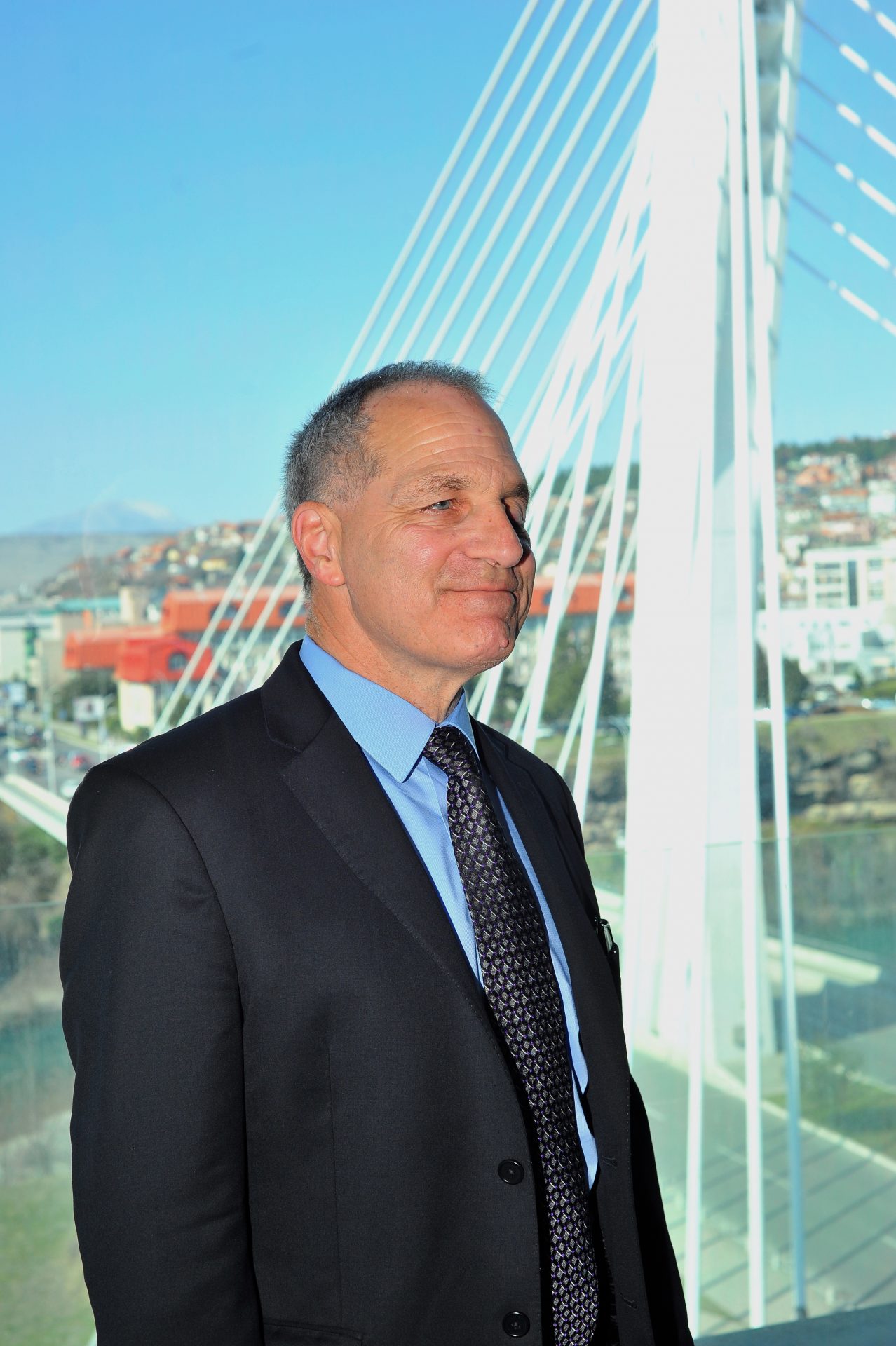
Former Director of the Federal Bureau of Investigation (FBI) and federal judge, Mr. Louis J. Freeh, enjoys great respect in the United States. He investigated the notorious Italian mafia, Cosa Nostra, for years, and was a friend of Giovanni Falcone. Today he is a member of the Board of Directors at the Universal Capital Bank in Podgorica. What can he do to help a fast-growing bank in our small Montenegro? CdM spoke to Judge Freeh, the director of FBI for eight years, appointed by President Bill Clinton, whom he investigated – twice.
CdM: When your name is Googled, the first thing that appears is the Pizza Connection case. It seems that this was one of the most important cases for your career, and possibly even the FBI. What happened, exactly, and why was it so important?
Freeh:The Pizza Case actually started as an FBI investigation in the early 1980s and the case identified a large group of Sicilians in New York City working with American La Cosa Nostra members of organized crime, who were not Sicilians, but had been in the United States for many years, and it was a very large conspiracy. They would bring heroin into the United States and sell it. And the operation in the 1980s was generating hundreds of millions of dollars in cash for them. They were taking the cash and flying into Switzerland in the days before sophisticated money laundering. They had a group of Swiss bankers who assisted them and a group of Sicilian partners. Their job was to bring the morphine base which originated in Iran, bring it into Bulgaria, then into Italy, where it was refined into heroin, and then the heroin was transported into the United States. It was a channel that’s not used anymore. 20 years later the South American cartels took over that trade or the Chinese controlled it from the Pacific side. But in the 80s, it was a central part of how American organized crime and Sicilian organized crime made billions. There were also bribes of public officials, murders, and deadly wars between different groups. So it created a lot of other serious criminal activity in the United States, Italy and around the world.
CdM: That’s when you started intensive cooperation with the Federal Bureau of Investigation?
Freeh:The FBI came to me when I was a prosecutor in New York City. I started conducting the investigation and found out there was a young Sicilian magistrate judge who was also looking at some of the same people. A very heroic man named Giovanni Falcone, himself a Sicilian. So I met him – first in Italy and then in the United States.
This was in 1984-1985. We realized that we were investigating the same people and we also understood that if we joined our forces together, we’d have a much stronger group of prosecutors. So we put together what we call a task force. Judge Falcone and I were the prosecutors and then we aligned the FBI agents with the Italian National Police.
And there was a very courageous and talented young police officer named Gianni De Gennaro, who later became the head of the Italian police – he was the FBI’s most important counterpart in Italy. And what happened there was a very strong combination. So we had a group of FBI Agents who were actually Italian born, three of them were born in Sicily. They came over to the United States as young children, they spoke fluent Italian and Sicilian dialect, and they were investigating for the FBI and directly partnering with the Italian police, going out on interviews in the United States, doing physical surveillances, following people, doing technical surveillance, and listening to people’s conversations with a court order.
It was a very powerful team and, ultimately, we were able to indict many people in the United States. The main target was a person named Gaetano Badalamenti, who at one time was the head of the Cupola, the body that controlled the entire mafia in Sicily. And the United States had very senior members of the La Cosa Nostra working in partnership with their Sicilian counterparts.
CdM: And you were able to bring the whole investigation to trial?
Freeh:Yes, I brought the whole investigation to trial in New York City in 1986-1987, called the Pizza Connection Case, and Judge Falcone brought the Maxi Trial in Sicily, which was held in Ucciardone prison because they needed a place big enough for all these defendants. He had a couple of hundred defendants, and I only had twenty-two defendants. Over many years, we became good friends, in addition to colleagues.

CdM: So you were the main partner to Falcone in the United States, and he to you, in Sicily?
Freeh:Exactly. The FBI Agents were working with him in Sicily with the permission of the Italian police, and the Italian police officers were in New York. The Italians lived in New York for several years and they would work with us directly. It was the first time that two countries had cross-designated their police and prosecutors to work together against organized crime. This case really transformed the FBI from a national police agency into an international police agency. In those days, the FBI had twelve offices overseas. Today, we have over 100 and we work with police officers literally all over the world. I mean we work with Russian and Chinese police officers even though the political leadership barely talks to each other. The police work together. So that case and Judge Falcone’s work really transformed the FBI into a completely different organization, and established the FBI – Italian national police relationship. We also worked successfully with the Guardia di Finanza, the financial police, and Carabinieri, two excellent police organizations.
In May 1992, Judge Falcone was assassinated in Palermo. When I heard the news, I told people that I was shocked and saddened, but not surprised. It did not surprise me because we knew for many years that the mafia families in Sicily were looking for an opportunity to kill him. And the government moved him from Palermo to Rome. They gave him another job so he would get out of Palermo. But his home was in Palermo, and he and his wife went back there on weekends with a protection detail. The attack was planned in great detail, with kilos of explosives put under the major highway between the airport and Palermo. The entire road was blown up as the motorcade passed over the bomb. The police in the first car were killed. Falcone was driving the car; his wife was next to him. The police officer driver was in the back seat and he survived. Falcone and his wife were killed.
Again, it was a very shocking murder but we were not surprised. We were very sad, but not surprised. So we reacted. We reacted very strongly to this assassination – which was followed in a few weeks by the murder of another anti-mafia judge in Sicily, another friend named Paolo Borsellino.At the time, I was a federal judge but still closely associated with the FBI. So the FBI put together a special team of investigators, sent them to Palermo, worked very closely with the Italian police and ultimately arrested and charged the mafia members responsible for these horrific murders.
CdM: Totò Riina ordered the hit?
Freeh:Yes, Totò Riina was the person responsible for ordering the assassination. And we had FBI agents who were doing forensic examinations of the cigarette butts that the bombers left on the mountainside. We took the DNA. We identified people. We did electronic surveillance. And then we also got Italy to change its laws, to make conspiracy a case that you could prosecute. We had Italian law changed to establish a witness protection program, and to allow broader electronic surveillance to listen to conversations with a court order.
CdM: This was during your time as the director of FBI, or before?
Freeh:It was during my time as director.
CdM: And then you were the first FBI director to actually go to Palermo, while Italy was still struggling with the mafia? It was a very dangerous thing to do.
Freeh:Yes. Well, Italy was struggling. Other prosecutors had been killed. Police officers were murdered. In the United States, we’ve had a very violent criminal history, but very few judges or prosecutors have been killed. Only three judges have been killed in the history of the United States, so it’s a different danger. When I was a prosecutor, FBI director, Judge in the United States, I never considered myself in danger. But my colleagues in Italy, particularly in Sicily, were always in great danger and we would worry about them all the time because there was an organized attempt to kill, threaten, scare and intimidate judges, prosecutors and police.
CdM: But still, being there at a time like that, it was surely dangerous?
Freeh:Well I suppose so, but I had been an FBI agent in New York City many years before that and it did not seem to be dangerous to me.
CdM: Bill Clinton appointed you the director of FBI, and he praised you when he did it. Later, he went on to say the decision was his biggest mistake. Your response was that his words were actually like a badge of honor for you. What did you mean by it?
Freeh:Well, I can’t explain why he said it. What I can explain is that when he appointed me as FBI director, he didn’t know me. I was a judge. I had been appointed by the first President Bush, who he beat in the election. And when he interviewed me for the job, I didn’t know him. I was very honest with him, I said – “You know Mr. President, I should tell you, I didn’t vote for you”. And he laughed. He said – “I didn’t think you voted for me, but I’d like you to take the job anyway.”
So, what happened is after I became FBI director, I had to open up a criminal case against the president, which I’m sure now sounds familiar to everybody. He was the subject of a criminal investigation that I conducted, and I think he reacted badly to it, instead of just seeing it as me doing my job. It wasn’t personal, or against him. But I think he saw it as a personal attack or disloyalty, so by the end of my term he was very unhappy with me. He made that statement. He said it was the worst decision he ever made. But I was just as happy to have him say that, as if he had said it was the best decision he ever made.
CdM: You see yourself as someone who cannot be influenced?
Freeh:Well look, everybody can be influenced. What I hope is I get influenced by facts. I get influenced by things that are not related to somebody’s personal agenda or plan. I’ve always tried to be independent. I’ve conducted a lot of investigations since leaving the government. And a lot of my clients – universities, companies, individuals – hire me because they believe I’m going to give them an independent opinion, which I do. Sometimes clients don’t like that. Sometimes a client will ask me to do an investigation and then I find the company has made some very bad criminal mistakes. Sometimes they don’t want to hear that and they say, “Well why did I hire you then?” And I say – “Well you hired me because you wanted to know what was going on.” We can manage the mistakes, but we can’t manage the facts. So, you have to accept the facts and deal with them.
CdM: And today you sit on the board of one Montenegrin bank. I don’t think Montenegro has ever had a person of your profile in any bank or any other institution. What brings you here?
Freeh:First of all, I’m very happy to be here. I’ve been to Montenegro several times, including when I was with the government. And I have a lot of interest in the country for different reasons. One, of course, as an American, this is now a very important country for the United States – not just as a NATO partner, but as the future EU member. Also, in my case, I have family members living very close by and I come to the region frequently as I like the Balkans.
When I was FBI director, I put many resources in the area to deal with narcotics, human trafficking, and organized crime. I’ve had a lot of association experience with banks. But most importantly, the owner of the bank, Petros Stathis, is a friend and a client I’ve known for many years. I represent him as an attorney, but I also have developed great trust and respect for him, for his integrity and for his work. He asked me to be on the board. It’s very common in the United States that clients ask lawyers to sit on their boards and because I had some banking experience in the United States with Fannie Mae, MBNA, Bank of America and Wilmington Trust, I thought I could bring some value here.
It’s very exciting that the bank is growing, as the country is growing. It is a very interesting market. And I hope I can add some business value, but also, I can bring to the board my experience policing money laundering and terrorist financing. All the risks that banks have to be aware of – whether you’re the UCB in Montenegro or the Chase Bank in New York – are the same risks. The most important one is reputational risk. A bank can be very damaged, as you see with Wells Fargo Bank now in the United States, Goldman Sachs, with 1MDBin Malaysia. Even very big banks can get into great problems by having their reputations questioned. So our goal here at UCB is to grow the bank economically. Its metrics are very positive and they’re trending in the right direction. We must have a strong compliance program. If we make a mistake, we’ll admit it and we’ll be transparent to our employees, our shareholders, our regulator here, the Montenegrin Central Bank, and that we put whatever controls we can in place that protect us from getting into trouble. But we also want to grow the bank and ensure that the business creates jobs and opportunities for Montenegrins.
CdM: So surely, before you were even nominated to be on the board, you vetted the bank? You are familiar with its business practices and operations?
Freeh:Yes, of course. I mean it’s a new bank in terms of banking legacies. When Petros Stathis took the bank over, it was really more of a small corporate account office for his family. But he’s transformed the bank into a very important retail and capital part of the financial market here in Montenegro. I did do some homework, I asked about internal audit reports, and any regulatory actions by the Central Bank of Montenegro against Petros, since he’s the major shareholder. There were none. I’ve asked and looked at the reports from the external auditor, going back to KPMG and Deloitte. We checked whether there were other parties suing the bank, either other banks or companies or customers. We found that the bank has a very good record, not just with the regulator, but with the public.
CdM: Do you believe a bank, any bank, can protect itself against false accusations?
Freeh:The most important way to protect yourself is to make sure that you’re conducting your business honestly, transparently, that you identify and manage all the risks. And that you have the facts to respond to a false story or a false allegation — whether it’s coming from a media outlet or an unhappy client or a competitor. Here, the facts are very strong.The problem with people who make false allegations is they don’t have any facts. And then when you check the facts, it becomes clear that the allegation is false. If someone defamed an individual or company, and the nature of the false claim is reckless, you can get sued and may have to pay lots of money in damages.
CdM: How much money are we talking about?
Freeh:We’ve had recent libel and defamation cases in the United States where the defendant has had to pay literally hundreds of millions of dollars. People should be very careful about making false allegations, and in the proper circumstances, you must also consider taking legal action against a person or company, whether it’s a newspaper or a competitor that makes a false claim or a false allegation. You take them to court where they have to produce facts to support their claim, and if the claim they made was reckless and intentional, then at least in the United States and many other countries, like the UK, they have to pay damages, because false claims against people and banks cause harm. If somebody is doing that on purpose and in a reckless, malicious manner, they should have to face the consequences.
CdM: You probably reviewed Montenegrin regulations for financial institutions and banks. Do you believe Montenegro complies with international standards?
Freeh:Yes, my understanding is it does. I need to study it a little bit more, but my initial review is that the banking system here, which is overseen by the Central Bank, meets the standards of the European Union, World Bank, SWIFT, FATF, OECD and other international standards of regulation.
CdM: You also mentioned, while we were preparing for this interview, that it is very important for Montenegro to be ready to adapt its laws. According to you, banking regulations are changing worldwide?
Freeh:Yes, exactly. The regulatory requirements for financial institutions and banks change very quickly now. There is a lot of fear and anxiety by regulators and political leaders that banks can be severely harmed, which in turn, harms the economy of a country. It could even put a country into recession or depression. So, for global banks, even small banks like our bank, the UCB, you have to be tracking and monitoring regulatory changes and then adapting to them. As Montenegro moves towards EU accession, you want to take on board all the necessary regulations and requirements. So that, when it is time for accession, the portfolio relating to the financial institutions will be current with the EU standards and make the transition a much easier process.
Again, I am very happy to be here. I am very excited about working with this bank. It’s a beautiful country and it’s an exciting place. I spend a lot of time in Europe, a lot of time in the Gulf, a lot of time travelling, and this is a great and exciting opportunity. I am grateful to Mr. Stathis, the Board and the director of UCB for inviting me on.
Boris Darmanović