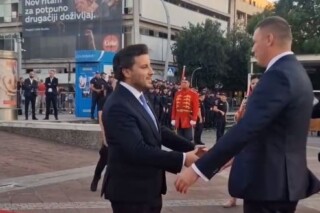
Today, he met with Montenegrin minister of foreign affairs and European integration, Igor Luksic. The ministers signed an agreement on the programme of cooperation between Montenegro and Austria in the fields of culture, science and education.
Kurtz reminded that Austria maintained strong ties with the Western Balkan countries, including Montenegro.
He also said that Austria strongly supported EU membership of all countries in the Western Balkans and reforms on their path towards the organisation.

He stated that one of today’s topic with Luksic was refugee crisis that affected Austria and EU members.
“But Montenegro is neither the final destination nor a transit country,” Kurtz told reporters.
He reminded that Austria would introduce an upper limit or quotas for the entry of refugees, adding that the country would be forced to stop the influx of refugees on the borders, which will have consequences for the entire region.
Luksic said that he sees Kurz’s visit as the possibility of applying what was agreed at the summit in Vienna.
According to him, we need further work to eliminate various forms of business barriers in order for Montenegrin market to be attractive to partners from Austria and the EU.

When asked about the parliamentary dialogue, Luksic stated that he had informed the Austrian foreign minister about the matter.
“At this point, it is difficult to predict the timing, but I believe that all the participants are interested in reaching the maximum level of understanding as soon as possible,” said Luksic.
When it comes to NATO, Luksic said that support for the membership in the Alliance is growing.
”According to latest surveys, there are ten percent more citizens who support Montenegro’s membership in NATO than those that oppose”, said Luksic.
He said that this issue should be left to the competent authorities, stating that the Parliament decides on the method of ratification.
When it comes to migrant crisis, Luksic said that Montenegro would synchronise its policies with the countries of the region and the EU.
He noted that Montenegro had already prepared an action plan in certain situations.

Asked whether investment by Russian businessman Oleg Deripska in the Montenegrin coast means the renewal of cooperation with that country, Luksic said that Montenegro’s relations with Russia has not been interrupted for 315 years.
“Even now, our political relations have not been breached. There are a number of investments in the field of tourism. This only confirms that Montenegro is not closed for economic cooperation with any of our partners. On the contrary,” Luksic said.
Asked whether it would endanger Montenegro, if Austria and some countries in the region closed the borders, Kurz said it would have consequences for the entire region.
“There is a possibility that some countries would become a part of a transit route, although they have not been in that situation previously,” said Kurz.
According to him, Montenegro is not on the route, but there is a possibility to become part of it.