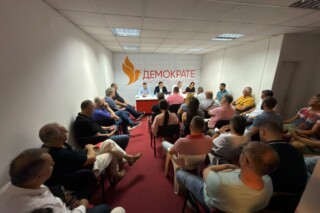
In Montenegro politics is still men’s job. This was confirmed yesterday after the constitutive session of the Parliament of Montenegro which had fewer women than the previous convocation. According to the Report of State Election Commission on the result of the election of MPs and their order on electoral lists, the new convocation has 18 female MPs, 3% less than in the previous convocation.
SDP has one woman on its list, just like URA and Bosniak Party.
‘Peace is our nation’ coalition has two women on its list, which accounts for 20% of the number of seats (10).
Electoral list of the coalition ‘For the future of Montenegro’ has 6 women, while DPS list counts 7 women.
“Judging by the DPS list, longstanding MP, Ms Nada Dobnjak, will not take part in the new convocation of the Parliament. Ms Drobnjak advocated for the respect for the principles of gender equality and served as president of the Committee on Gender Equality”, NGO Center for Women’s rights says.
This NGO believes that the figure would be even lower if there wasn’t a defined quota for women, regulated by law.
CdM asked the negotiating teams (consisting of men) for comments, but we haven’t received any answers.
Center for Women’s Rights believes that there can’t be any changes without participation of women in political processes.
This NGO expected more from the start.
“We expect you to conduct gender-sensitive and inclusive policy. We believe you know that women are carriers of the negotiation process, that they have been making significant contribution to social changes, fighting on a daily basis for the well-being of the society, ensuring survival for their closest ones in conditions of unemployment and poverty ”, they point out.
They refute frequent claims of politicians that women are not interested in politics.
“It is known that women built and established democratic practices long before democratic was established as a form of rule. It is very irresponsible to leave the out in this way, to neglect the potential Montenegrin women have. We demand you immediately include 30% of women into negotiation process and all other process and incoming reforms”, NGO said.
The Kenya’s case

Kenya’s supreme judge has advised the president to dissolve the parliament dominated by men, saying that lawmakers failed to meet constitutional provision allowing for women to hold one-third of seats.
In contravention of the Constitution from 2010, which states that over 2/3 of any appointed or elected body cannot be people of the same gender, women only take 22% of seats in the lower house of the parliament and 31% in the upper house.