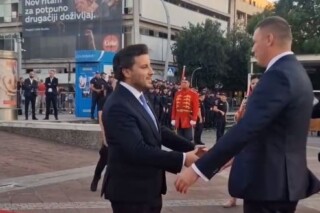
Good morning! After a long time, the perception is that Abazovic is now the one who raises tensions, and Djukanovic lowers them, Abazovic is the one who mines the path to the EU, and Djukanovic is a constructive factor. What happened?
First of all, I want to express my great pleasure that the member of the CdM team, Andrej Nikolaidis, was among the candidates for this year’s 13 July Award. Full support for his candidacy and that of Bobo Batricevic.
How Djukanovic outsmarted Abazovic
No one is clear about the term and Abazovic’s promotion of the so-called Fundamental Agreement with the Orthodox Church of Serbia (hereinafter SPC). At a moment when there are clear signals that Montenegro should take advantage of the momentum and put pressure on the EU regarding membership, by simply fulfilling its obligations, Abazovic takes and detonates a bomb with a topic that divides Montenegrin society. He vehemently forces the settling of relations with the SPC, which seems not to be a priority even for the Serbian Church itself. A logical question arises as to why Abazovic did this, and why exactly now.
Why does Abazovic so energetically want to please Vucic, why does he provoke the Montenegrin public so much that he openly admits that he is ready for the fall of the government when it comes to these issues that divide society?
Populist reasons are the first thing that comes to mind. URA has lost a lot of support from the Serbian electorate by entering into an arrangement with DPS. Perhaps with this Abazovic wants to get back part of that support.
However, there is also something much more perfidious, and that is the possibility that behind this whole arrangement there is an order, excuse me – a request from Aleksandar Vucic, who wants to slow down Montenegro’s path towards the EU. The entry of Montenegro into the EU before Serbia and on its own without the rest of the region would be perceived as a defeat for Serbia.
Unlike Serbia, Montenegro is a society of political pluralism, and there are serious efforts to strengthen the rule of law. Unlike Serbia, in Montenegro the vast majority of the population wants to join the EU, in Serbia this is not the case, the majority is against membership. Montenegro cannot wait for Serbia and the other countries of the region to solve their problems, so that we all together become part of the union. There are serious efforts in Serbia and the Serbian civil sector to integrate the region as a package. The destabilization of the situation in Montenegro through relations with the SPC should perhaps be viewed in that light.
But what does all this have to do with Djukanovic? While Abazovic was in Belgrade and building broken fraternal relations and triumphing in his self-deception, he may have expected that violent protests would break out in Montenegro, and that he would once again be able to point the finger at DPS and Djukanovic as the main culprits for destabilization. But Djukanovic outwitted him from Madrid, where he was staying at the Summit with an escort from SDP.
It is possible that the President was encouraged by the jumping of Ranko Krivokapic, who was running and jumping all the time to catch up with him, and felt that time was working for him again and sent a message to calm the tensions. And so, he once again demonstrated his political genius. It occurred to me that he encouraged Abazovic to go to Belgrade like this, but I should not exaggerate.
Although at the first moment I suspected the motives of Djukanovic’s move, and thought that he was making compromises with URA to the detriment of Montenegrin national interests, after Milos Konatar’s tweet of support and the headline on IN4S in which “Milo betrays the komitas” it became completely clear to me that the intention to once again prove Montenegrins to be the main factor in the destabilization of Montenegro is thwarted.
That’s it for today and this week. See you again on Monday.
Kind regards,
Ljubomir Filipovic, CdM analyst