By Andrej Nikolaidis, CdM columnist
Pljevlja has become an incubator in which the new social reality of Montenegro is developing. As is Niksic. And Budva. And Savnik…
In fact, the entire Montenegro has become a center for innovation. Which can hardly surprise anyone. Certainly not those who, with their effort and will, created conditions for the development of Montenegro based on the principles of so-called “alternative history”, “alternative democracy”, “alternative Europeanism”…
The first man of Pljevlja turned Chetniks into “fighters for freedom”. And equated them with partisans. That’s how he and his people see reconciliation.
Of course, this is not about reconciliation. It’s about brutal violence over the living. And the dead.
“Even the dead won’t be safe if the enemy wins,” Benjamin writes in VI. Historical-philosophical thesis, adding: “And that enemy didn’t stop winning.”
If we manage to break through the diluvial charm of his statement, the fake conciliator from Pljevlja actually says the following:
a) The Germans fought against the partisans. And they, the partisans, were the fighters for freedom and anti-fascists.
b) Partisans fought against the Germans. German soldiers were fascists and occupiers in the WWII.
c) The Chetniks fought with the Germans against the partisans. It may be concluded that the Chetniks were the fighters for freedom and anti-fascists.
How do we call that logical operation?
Of course, that procedure is not logical, but primarily anti-ethical. It’s called lie.
It’s a powerful procedure. Kafka says in ‘The Trial: “The order in the world is built from lies.” Both in the world and Montenegro. In Pljevlja as well.
The Khmer Rouge once declared the date they seized power as Year Zero: the new birth of Cambodian history and true tradition. This is a common practice of totalitarian ideologies: claiming that history begins with them.
The new Montenegrin government is persistent in doing the same: it claims that Montenegrin democracy and the “long journey to Europe” begins with their victory on August 30, 2020. So they name means of transport after that date. That date becomes the day when the people supposedly expressed their will, which will be respected forever, regardless of the result of the elections that will follow. So, after the 2023 elections, they call on respecting the 2020 election results. Which means that we don’t need any of the future elections.
They will be organized just to confirm 30 August 2020, or their result will not be recognized. The power won in the counter-revolution will not be handed over in the elections – that must be clear to everyone. Well, the mentioned glorious date becomes the day of birth of the new, democratic, inclusive, anti-corruption Montenegro. Free Montenegro. In which there is no freedom for the enemies of freedom. Which, by the way, is the very definition of non-inclusiveness: no inclusiveness for the enemies of inclusiveness.
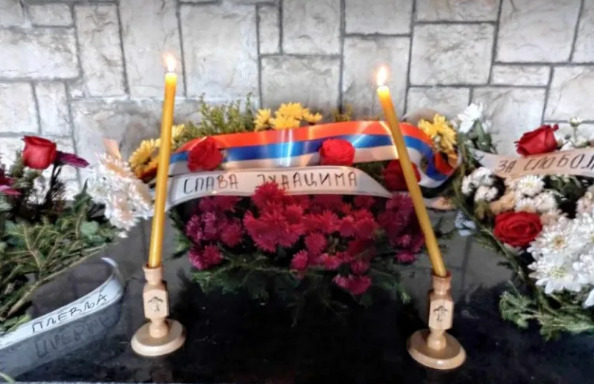
The fake conciliator from Pljevlja paid tribute to those who fought for freedom by fighting with the occupier against the fighters for freedom, at the place where the partisans killed them. Why didn’t he do it at the monument to the Chetniks who fell in the fight against the Nazis? Wouldn’t such an act confirm his thesis about the Chetniks as fighters against the occupiers?
The answer is simple. No, because there is no such monument. And why? Simple. Because there are no Chetniks in Montenegro who died in the fight against the Nazis. There is no battle that the Chetniks fought against the occupiers. Not even a raid.
The Chetniks fought against the Partisans. That is why Chetnik apologists are forced to visit the places where they died at the hands of the Partisans.
Any dogmatic interpretation of the past is narrow. Of course, there were people who joined the Chetniks thinking that they would fight against the occupiers. But their personal tragedy does not change the collaborationist essence of the Chetnik movement. Just as the personal tragedy of the young Germans who were mobilized into the Nazi troops does not change the criminal essence of those troops.
Let’s say someone’s grandfather was a thief. Let’s say he was forced to steal to feed his family. His ethically dubious position cannot be resolved by declaring him a fighter against corruption and the statement “you should not steal” being interpreted as fueling tragic divisions.
Reconciliation is necessary. It’s always necessary. “Let the dead bury their dead,” says Jesus. The past should be left in the past. But no: we constantly turn what should have passed into a past that refuses to pass.
The so-called “reconciliation” implemented in Montenegro is the opposite of reconciliation. It’s an effort to declare the mistake of the past as a principle on which the future should be built. We legitimize our own mistakes as faithfulness to the mistakes of our ancestors. In this way, we try to present our own unethical actions as the pinnacle of ethics, as fidelity to the traditions of the community. No one does a greater injustice to the ancestors than those who do so.
(The opinions and views of our columnists aren’t necessarily those of the CdM news team)