The article is written by Andrej Nikolaidis, CdM columnist.
“Theodorus will be happy for my death,
as someone else will be happy about Theodorus’ death,
yet all speak ill of death”,
writes Ezra Pound in Hommage to Quintus Septimus Florentis Christianus.
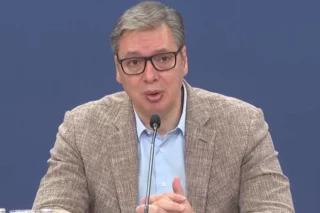
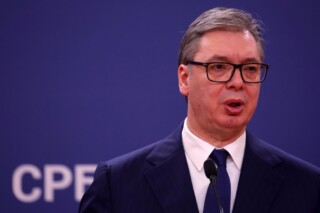
Speaking of death, speaking of Vučić. Krivokapić who, if it weren’t for him, would have watched the government only from the street, in a parade, speaks badly about him. Ivanović speaks badly about him, who without Vučić would not be the owner of the regime’s media for sale today, nor would he appoint his associates to state institutions, and send his ambassadors around the colorful and distant world. People talk badly about him on social networks: it seems fair to say that Vučić is only slightly more popular among Montenegrin citizens who declare themselves as Serbs than among those who declare themselves as Montenegrins.
Vučić has been successfully destabilizing Montenegro and Bosnia-Herzegovina (and even Macedonia) for years. He dethroned the Government in Podgorica, with the tacit consent of Western democracies. He casually and without negative political consequences launched the idea of the Serbian World into the mainstream. He is arming himself. He takes over media in the region. He is successfully launching initiatives aimed at making Serbia a regional hegemon. Through his media and think tanks in Montenegro, he elegantly launched the thesis of equality of Serbian and Montenegrin nationalism – which is nothing but the abolition of nationalism that has resulted in hundreds of thousands of dead and displaced in the last quarter of a century, ethnic cleansing, refrigerators full of corpses, mass graves and genocide. It is a truly small masterpiece of propaganda: equating nationalism whose statement is “I am a Serb and you are all Serbs” and nationalism which has nothing of the above on its black account, and whose statement is “I am a Montenegrin, and you be whatever you are”.
Vučić placed the thesis on the equality of two nationalisms, one of which is a constant source of conflict in the region and the ideological matrix of the local wannabe empire in an attempt, and the other the typical anti-colonial nationalism of Tito’s non-aligned, while the other nationalism exists as a possibility, not as a reality. He held practically one-party elections and formed a practically one-party parliament – and the West accepted all that. He constantly functions outside his constitutional competencies, controls everything, even the sparrows in the country, and the West still treats him as a democratic leader.
Therefore: why, brothers and sisters, why speaking badly about Vučić if his goals are also your goals? Why, when he achieves those goals more than solidly?
Here is why: because Vučić, as my good friend noticed, is a modernizer of Serbian nationalism. And the modernizers, especially of something as retrograde as nationalism, encounter (in Vučić‘s case: a poor, barely existing) resistance: that is their destiny.
What do I mean by “modernization of Serbian nationalism”?
The answer seems obvious to me, but let me list the arguments anyway.
The Serbian world is a Greater/Homogeneous Serbia 2.0. The concept has been updated to combine territory control and so-called soft power. It implies the strengthening of economic influence (which is legitimate and legal) and assimilation (which is not illegal, even less unknown to the great European states), instead of the brutal (para)military control that characterized the great-power attempt led by Milošević.
The focus of the Serbian World is no longer Kosovo or Montenegro, but part of Bosnia-Herzegovina – the entity of the Republic of Srpska. Kosovo is lost and serves only as a means of political trade to put pressure on Bosnia and Montenegro.
Which, after Vučić‘s reform, no longer has a privileged status within Serbian nationalism. It is no longer “the other eye in the head”, “Serbian Sparta”, “guardian of freedom and historical continuity”, but only a fragment of the Serbian World, whose heart is the Republic of Srpska…
The Montenegrin Metropolitanate is no longer “second after the patriarchate”, but only “fourth within the Serbian Orthodox Church”. It was clearly announced from Belgrade that the Bosnian department is now in front of the Montenegrin metropolitanate. The Metropolitan of Montenegro and the Littoral is no longer “second after the patriarch”: there is no place for him in the synod.
Vučić‘s Serbness is not a Kosovo vow, but a Bosnian vow.
Amfilohije was aware of what was said – that is why Vučić irritated him so actively.
Serbian leaders are no longer of Montenegrin origin (like Milošević and Tadić) – both Vučić and Porfirije are from Bosnia.
The new reality was summed up by the last in a series of those who bowed to Vučić: Joanikije. When he says: “The ruined Lovćen chapel that was sacrificed is constantly multiplying and in that way the whole great swing of the chapel will end when it returns to Lovćen again in the constellation of the great Lovćen chapels all over the Serbian lands”, Joanikije abolishes the singularity, thus diminishes the significance of Lovćen and the chapel for Serbian nationalism – Lovćen and the chapel are no longer the roof, the crown of that nationalism, but only a part of the “constellation”, equal to other stars “everywhere in the Serbian lands”.
After Amfilohije‘s death – and with him, symbolically, the old concept of Serbian nationalism in Montenegro ended – all plans and deals between him and the author of the thesis on the “emancipatory potential of the Metropolitanate of Montenegro and the Littoral” became just aimless wandering around old maps of past reality.