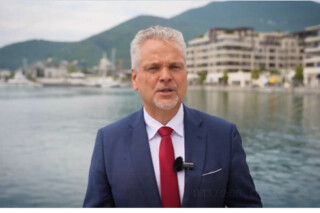
Lange, the head of Unit for Montenegro within the European Commission’s Directorate General for Enlargement, said after the meeting of the Subcommittee for Justice, Freedom and Security, that Montenegro is currently at the stage when the implementation of action plans is moving towards concrete results.
“This is the stage when we have to see how we will start to get results following this period of establishing the institutions. When it comes to the development of this situation, our attitude in the past five or six months was to encourage all political parties to participate in the political dialogue and to work in order to see whether it is possible to reach some compromises and common solutions for the benefit of the entire country,” Lange said in a press conference.
He pointed out that the new electoral legislation, the application of which should be provided in an appropriate way, was discussed at the meetings of the subcommittee, Mina news agency carried.
“Institutions such as the Anti-Corruption Agency will play a key role in controlling the financing of political parties and these are goals that all political parties should strive to in order to ensure conducting of the next elections in a proper manner,” said Lange.
Asked why the work of the Anti-Corruption Agency did not give results, he stated that this body needed to work for the benefit of Montenegro.
“The agency has existed for only two months and I think it would be too much to expect that in two months such an agency produces 100% successful results,” he said.
According to him, he would like to see the agency’s results, but that he understands if it takes a little more time for everything to start functioning. Commenting on charges for high-level corruption, Lange pointed out the positive steps made in that area, stating that another step forward must be made now.
“We do not want to see only the well-equipped offices, but also that the results are achieved and that there are criminal prosecutions. This is what needs to arise from the establishing and equipping the institutions,” said Lange.
The general director for European affairs at the Ministry of Foreign Affairs and European Integration, Snezana Radovic, said that the meeting of the subcommittee was an opportunity to see that the rule of law takes place in the right direction, according to the obligations defined in action plans for chapters 23 and 24.
“We can be particularly satisfied with the results achieved in the legislative area. Since September 2013, we have adopted 52 reform laws, 19 of which have been adopted in the period between the last year’s and this year’s subcommittee’s meeting”, said Radovic.
According to her, this year the Draft Law on Asylum should be adopted.
She also said that that the legislative reforms were followed by strengthening the existing and establishing new institutions.
“First of all, this refers to the establishment of the Special State Prosecutor’s Office for fighting against corruption and organised crime, the Anti-Corruption Agency and the recently appointed head of the Special Police Team,” said Radovic, noting that it provided preconditions to intensify activities to achieve the balance of results in the fight against organised crime and corruption through new investigations and indictments.