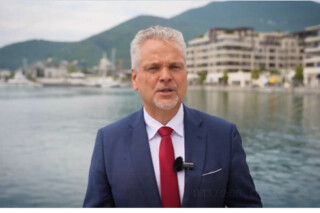
“The most desirable way out of the crisis would certainly be early parliamentary elections, and the Democratic Party of Socialists (DPS) is completely ready for them. However, although the most desirable, early elections are not the only way out of the crisis. The DPS is ready to support any solution that will lead to the fall of the current government, which would eliminate the risk of endangering the vital strategic interests of our country. It remains to be seen what the solution will be in the end”, says DPS MP and spokesman Milos Nikolic in an interview for CdM. He points out that the partners of the DPS can be those parties that nurture the anti-fascist heritage of Montenegro, the concept of a civil state and advocate for the European future of Montenegro. At this moment, Nikolic says, only the Democratic Front (DF) excludes itself from this possibility. According to him, if we really want to make real strides for the future of Montenegro, then we must reach a majority that is significantly larger than 41 MPs. So, he points out, only a majority of 54 or 49 PMs can provide what Montenegro needs – unblocking of key judicial institutions and strong support for membership in the European Union, and the key word for reaching that majority is – compromise.
CdM: In an interview in 2017, you said that a greater contribution of the DPS was needed to strengthening the identity and overcoming divisions. It is obvious that a large number of pro-Montenegrin bloc voters do not hide their dissatisfaction with the political situation in Montenegro. However, we often hear comments from them that you from the largest party of the former government are to blame for that, because you did not use the best ways to strengthen the state, its institutions, to allow corruption, allow foreign interference and lack of international support. Is there any truth in that?
Nikolic: As for the first part of the question, I would say that there is no doubt that the biggest problem of modern Montenegro is the inherited deep division of society. I say inherited because we are aware that the roots of today’s divisions date back at least 100 years. (…) As for the second part of your question, I am familiar with it and, of course, with such interpretations. I would say that they are more the product of a kind of resentment and frustration with the current situation than some serious political analysis.
I believe we did more than could have been done. Montenegro has strategically wisely chosen the country’s foreign policy course and has achieved exceptional results in that field. I would like to remind you that we have become a member of all relevant international organizations, including NATO, and that we have opened all chapters in the negotiations with the EU and closed three of them. Internally, the Montenegrin economy is much stronger than it was 14 years ago. We were record holders in Europe in attracting foreign direct investment, we completed the process of turning Montenegro into a year-round high-paying tourist destination, we developed evenly the north, especially through the ongoing highway and ski projects. The data from which the evident growth can be seen speak best about salaries, pensions, minimum wages. However, 14 years is not enough to complete the process of state formation in the institutional, identity and economic sense.
CdM: The Montenegrin bloc is encouraged that the international community has recognized the mistake of giving support or not reacting in the last elections due to the interference of other foreign powers in the elections in Montenegro. Is it just encouragement with a message – Hold on until some next elections?
Nikolic: I would say these are banal and superficial comments. Neither did the international community give such strong support to the new government last year, nor will it now tend to resolve what the internal issues in our country are. The peaceful transition of power is a great asset that Montenegro gained after last year’s parliamentary elections and it is an important event for Montenegro’s reputation as a democratic state. Could there have been more active action of the international community in the part of protection of Montenegro from malignant influence of third parties? Of course, there could.
CdM: When will the next Elections be?
Nikolic: Early parliamentary elections are the most common way to resolve the political crisis in all democratic societies. So, I believe that the context of your question was – when will the political crisis in Montenegro actually be resolved. In this context, I believe that the coming months, and probably the coming weeks, will lead to a resolution of the current crisis. The most desirable way out of the crisis would certainly be early parliamentary elections, and the Democratic Party of Socialists is completely ready for them. However, although the most desirable, early elections are not the only way out of the crisis. There are some other modalities.
CdM: I’m sure you do public opinion polls regularly. You announced a part recently, and that is that the DPS has reached 35% to 38% of the electorate that would go to the polls. Tell us something that is not good for you in that survey. All political factors often deprive us of that.
Nikolic: From every survey we get, I can say, thousands of data. They are used to see the current position of the party, eliminate weaknesses, set a communication strategy and make some strategic decisions about future moves in the party. (…) The survey leaves no dilemma: if elections were held, the current parliamentary majority would go into opposition.
CdM: The Montenegrin bloc should go to the polls in one or two columns… or maybe three?Why?
Nikolic: The Montenegrin bloc should run in the elections in the modality that will offer it the best chances of winning. We are currently working on these analyzes and what I can say is that there are several options that we are evaluating. What will be the final solution in the end depends primarily on the assessment of the success of the parliamentary elections.
CdM: Has the DPS, after joining the opposition, been a reformed party, partially reformed, or something else?
Nikolic: The DPS is nearing the end of its intra-party reform. I understand that part of the public views this in the context of primarily personnel policy in the highest party bodies, but that is not the case. The DPS is a serious organization with over 50,000 members, and hundreds of various units of party work. If we want serious reform and elimination of all those shortcomings that led us to defeat in last year’s parliamentary elections, we must do the whole job thoroughly. This means that the reform is not only about changing the members of the Presidency but also about analyzing the work and performance of each individual in the structure.
CdM: Did President Djukanovic make political mistakes, and if so, which ones?
Nikolic: I believe it would be more correct to talk about the success of policies than any individual. Yes, the DPS had certain mistakes that we are fully aware of. I think that, from this distance, the key mistake was in the relationship of commitment to the strategic and daily needs of Montenegro and its citizens. We focused almost all our energy on those projects that we believed were the perspective of Montenegro and that would lead us to the desired results in five or 10 years. I am talking about the highway project, the Adriatic-Ionian highway, energy projects to make our country the energy hub of the region for which we have the potential, importing ski resorts in the north, European integration, strengthening institutions, etc. These are all jobs that take years, and some of them decades.
CdM: If you stayed in power, what would you do better?
Nikolic: If we had stayed in power, we would probably have been deprived of the analysis I gave you in answer to the previous question. Therefore, this question of yours can be reformulated in two ways: What are the three key things that would happen if you stayed in power, or what three key things do you intend to do better when you return to power. If we had remained in power, Montenegro would have had a total budget surplus for the first time by 2024, the first phase completed and new phases of the highway and the Adriatic-Ionian highway started, and all negotiating chapters in negotiations with the EU closed.
CdM: If you won any potential election, would you rule the same or different way? If different, explain as specifically as you can?
Nikolic: The DPS did not rule, but exercised power. This is a big difference because exercising power implies a significantly more complex process. So, when we exercise power again, a lot will depend on the overall environment and on who the partners in exercising power will be.
CdM: Tell us the name of the ruling party with which you could form a pre-election or post-election coalition.
Nikolic: As you know, for twenty years now, the DPS has had certain traditional coalition partners. This partnership is based on program agreement and togetherness in terms of views on certain values. In this context, the nurturing of the anti-fascist heritage of Montenegro, the concept of a civil state and the European future of our country stand out. All those who agree on these values can be our partners. At this moment, with the policy they have been pursuing for many years, the only one who excludes itself from this possibility is the Democratic Front. (…) In order for a compromise to be reached, it is necessary to rise from daily politics and narrow-party thinking and show leadership and even state capacities. Everyone on the European platform of the current parliamentary minority is ready for that. The ball is therefore with some leaders of the new parliamentary majority. Whether they will have the capacity and courage remains to be seen.